The policeman who predicted his killing for doing his job
During Guatemala's bloody civil war, all the police investigators that touched the case of the death of Myrna Mack, a famous anthropologist whose killing was commanded by leaders of the military regime, were killed. X years later, we reconstruct all the evidence of this circle of killings.
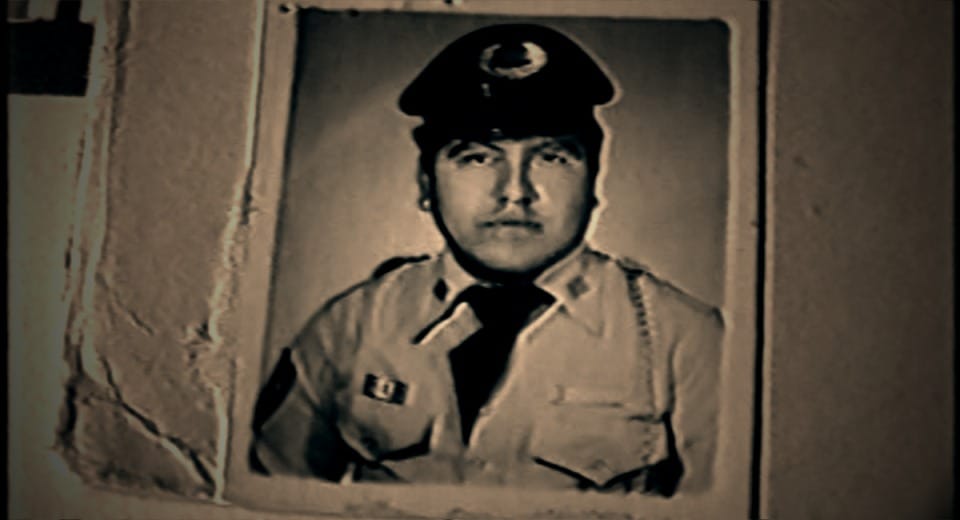
José Miguel Mérida Escobar knew they were going to kill him. He told his brother, his former boss, Rember Larios, and Helen Mack, the sister of the anthropologist whose death colleagues, agents of the Criminal Investigations Department of the National Police officers were part of the operation that sought—through his assassination— to silence the theory that Myrna Mack's death had a political background.
Forty days before he was murdered, José Miguel Mérida Escobar, the National Police investigator who had uncovered the alleged perpetrator of one of the most notorious crimes of the time, testified in court. On the afternoon of June 26, 1991, he provided Judge Eduardo Antonio Coromac Ambrosio with the information he had obtained regarding the murder of anthropologist Myrna Elizabeth Mack Chang.
Mérida said that Mack's murder was "possibly due to the work she did." Mack was an anthropologist and social researcher who worked in communities of internally displaced people due to the violence of the internal armed conflict in Quiché, and had co-founded the Association for the Advancement of Social Sciences (Avancso). In court, Mérida requested that the case be kept confidential for fear of her safety.
Perhaps out of fear, the investigator contradicted himself in that statement and expressed doubt about the two reports that considered different motives for the murder. The first, dated September 29, 1990, hypothesized that the crime could be political, due to Mack's work, and pointed to Noel de Jesús Beteta, an Army sergeant assigned to the Presidential General Staff, as a suspect. This report was kept secret within the police; few knew of its existence, and it was not in the case file. The second report, dated November 4, was the one used in the courts and concluded that the brutal murder had been the result of a common robbery. The first report had been signed by Mérida and his colleague, Julio Pérez Ixcajop; the second, by the head of the homicide section of the Department of Criminological Investigations (DIC), Otto René Tatuaca.
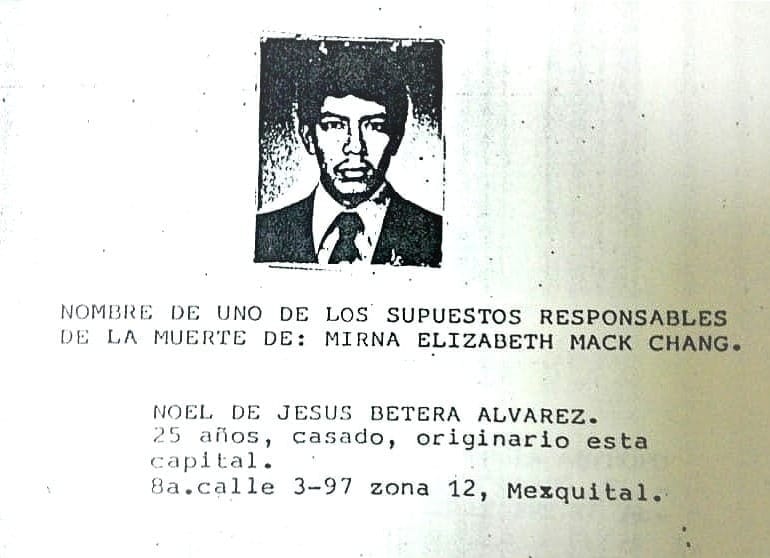
Skeptical, Mérida Escobar largely confirmed the September report but expressed distrust. “I partially ratify it… apparently, these are the reports we submitted,” he said. Regarding the document that indicated robbery as the motive, he stated that he did not fully ratify it because it omitted people he had interviewed and included others with whom he had not spoken.
Helen Mack, Myrna's sister and a plaintiff in the case, remembers that day. Mérida was summoned to testify at nine in the morning, but he wasn't seen until 5:30 p.m., after the office staff had already left. The Mack case file, which remains at the Human Rights Office of the Archdiocese of Guatemala (ODHAG), confirms that Mérida began testifying at 5:40 p.m. “The prosecutor who was handling the case didn't arrive; instead, an advisor from the Ministry of Defense showed up and presented Mérida Escobar with his card. It was obviously an act of intimidation,” Mack says.
As she left, Mérida told Helen Mack what she would later repeat to others.
—I have signed my death warrant
—It's not like you said that much— Mack replied.
At the hearing, Mérida Escobar confirmed his signature on the September report, although he asked, to avoid reprisals, that the speed of her signature be analyzed graphologically.
The investigator in charge of solving Myrna Mack's murder did his job. He interviewed vendors who frequented the street where she was stabbed. One of these witnesses had been a police officer and described a man he recognized: a former narcotics investigator who now worked for the Presidential General Staff. He had seen him watching 12th Street and 12th Avenue on a blue motorcycle. Mérida took note of the descriptions, which allowed for the creation of a composite sketch, and compared it to the name: Noel de Jesús Beteta Álvarez.
Mérida Escobar was born on February 7, 1955, in the village of El Sitio, Catarina, San Marcos. During the last months of his life, he sought exile, but refused to leave his family. When he was killed, he left behind his widow, Rosa Amalia, and his sons, Elder, Abner, José, and Edilsar. He wasn't very tall, but he had a strong build. During his career as a police officer, he specialized in homicide investigations and attended courses taught by specialists from the U.S. State Department.
According to Rember Larios Tobar, the former chief who assigned him the investigation, Mérida exposed himself by confirming to the press that he was the lead investigator in the Mack case, after giving his testimony. No other source could confirm these statements, only Larios, who claims that Mérida sought him out to get his opinion on the matter: “He had made a serious mistake by taking credit for the investigation, and that could cause him problems.”
“They told us to investigate to the very end,” recounts Larios, who recalls that the then-police chief, Colonel Julio Caballeros Seigné, promised to protect them, regardless of who the culprits were: military personnel, politicians, or criminals. “The president is with us,” was the promise. “The director was demanding it of me, and he said that the president was demanding it of him,” Larios asserts.
“I was afraid,” he admits, “but one of the mottos in the police is that orders are obeyed, not questioned.”
Larios continued his career in the National Police, but after Mérida's assassination, he went into self-imposed exile in Canada for fear of suffering the same fate. He returned to Guatemala years later, and between 2008 and 2009, he served as deputy director of the National Civil Police (PNC) during the controversial administration of Marlene Blanco Lapola . In 2015, Larios was arrested for drunk driving and assaulted and threatened his arresting officers.
Mérida's comrades and a militarized police force
During the civil war (1960-1996), the National Police (PN) operated according to military principles. Its directors, high-ranking officers, and instructors were all Army officers. Police culture—the way they were organized, and how they understood the roles and responsibilities of each position—originated in the structure of these military forces. Their operations were coordinated with the Army, the Presidential General Staff Archives, the Judicial Police, and the Treasury Guard through a Joint Operations Center.
“We considered ourselves little brothers, subordinate to the Army,” Larios points out.
The four former agents who, according to the Public Prosecutor's Office (MP), participated in the special intelligence operation aimed at assassinating Mérida Escobar worked at that institution. Three of the now-accused were his colleagues at the DIC: Alberto Encarnación Barrios Rabanales, José Miguel González Grijalva, and Julio David López Aguilar. They were arrested in June 2014. A year later, their superior, the then-head of the DIC, Martín Alejandro Mejía García, was also arrested. A fifth agent connected to this case, Lucas Edgar Martínez García, is a fugitive and is wanted by Interpol .
The five participated in the capture of Alfredo de Jesús Guerra Galindo and Gonzalo Cifuentes Estrada, scapegoats accused of Mérida's 1991 murder, who were later acquitted and reported mistreatment and arbitrary detentions. The prosecution accuses these former police officers of participating in an operation that sought to divert the investigation into Mérida's murder from the Mack case; they are charged with murder, abuse of authority, and crimes against humanity.
In his initial court appearance on June 24, 2015, Martín Alejandro Mejía, the superior officer who recorded the arrests, stated that he learned of Cifuentes Estrada's detention upon entering the office of the then-Director of the National Police, Mario Enrique Paiz Bolaños, as a group of journalists were presenting him as responsible for Mérida's death. Mejía claimed to be unaware of how the detainee arrived at his superior's office and explained that after the press conference concluded, Paiz Bolaños ordered him to formalize the arrest.
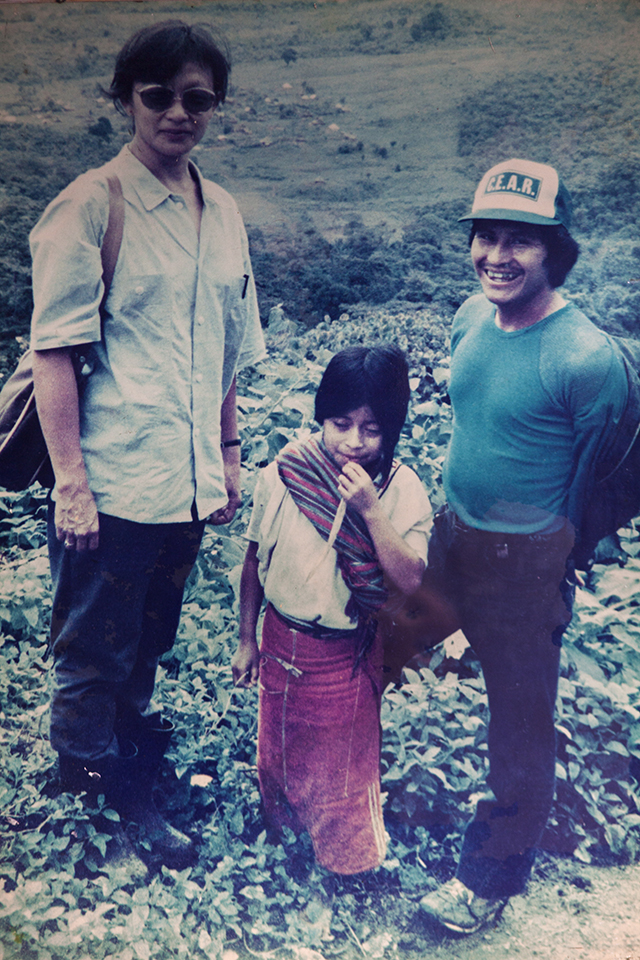
ideo testimony exists regarding Cifuentes Estrada, the prime suspect in Mérida's murder. In the recording, which was broadcast on a television news program, Cifuentes confesses to killing Mérida: "I murdered him on August 5th," begins the account in which Cifuentes Estrada incriminates himself on camera. He then accuses Mérida of having arrested him for a robbery at a Bandesa bank branch, and claims that the investigator had also arbitrarily arrested his wife. According to Cifuentes, Mérida physically assaulted his wife and raped her. "He ruined her," he said.
“I was in Concordia Park shining my shoes… I saw him… I couldn’t stand it and I killed him,” the alleged confessed killer recounts. Cifuentes gave details about the weapon and the vehicle he used, a pickup truck owned by former agent Alfredo de Jesús Guerra Galindo, the other suspect in this case, who would be captured later. That was a full-fledged confession, but according to Mack, the private prosecutor in the Mérida Escobar case, the video was a strategy to tarnish the investigator's name and divert attention from the real motive for his murder.
A voice off-camera (which, according to Mejía, belongs to Paiz Bolaños) asks:
—What is the full name of the agent… the gentleman… the former agent who lent you the vehicle?
—His name is... —And cut. Static. That's the end of the confession.
* * *
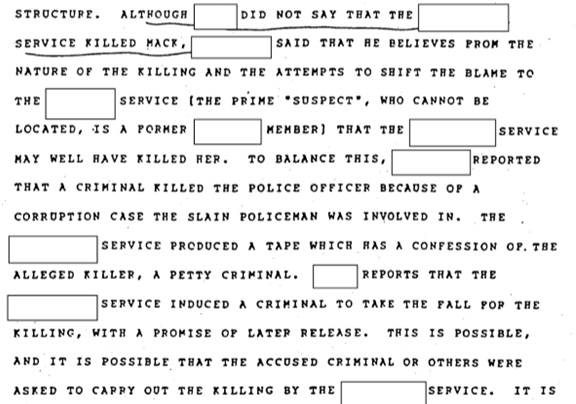
A declassified document from the United States Central Intelligence Agency (CIA), in a message from the clandestine station in Guatemala to headquarters, reports: “The □□□□□□□□□ service produced a video containing a confession from the alleged murderer, a petty criminal. □□□□ reports that the □□□□□□□□□ service induced the criminal to take the blame for the murder, with the promise of imminent release. This is possible, and it is also possible that the accused criminal or others were asked to carry out the murder on behalf of the □□□□□□□□□ service. It is also plausible that the □□□□□□□□□□ was not involved.”
* * *
Myrna Mack was murdered with 27 stab wounds on September 11, 1990. Her case became a paradigm in the fight against state crimes during the armed conflict, as it was the first criminal trial in which the perpetrator, Sergeant Noel de Jesús Beteta, was convicted, as well as the mastermind, Colonel Juan Valencia Osorio, then head of the Presidential Security Department. Beteta is serving a 20-year sentence, while Valencia remains a fugitive after fleeing justice with the support of the Army, following his 30-year prison sentence.
In 2004, the State of Guatemala acknowledged its responsibility for the extrajudicial execution and denial of justice to Myrna Mack.
That same year, Guatemala publicly honored the memory of Mérida Escobar. In 2005, his family and the State of Guatemala reached an amicable settlement in the extrajudicial execution case that was being prosecuted before the Inter-American Court of Human Rights. In the agreement, Guatemala committed to having the Public Prosecutor's Office investigate and identify those responsible for the murder and silencing of the investigator of Myrna Mack's murder.
One of the police officers now implicated by the Public Prosecutor's Office in Mérida's murder was also involved in the operation following Mack's murder in September 1990. Julio López Aguilar participated in the investigation the night of the crime, during which they excused themselves for not having collected any significant forensic evidence because it was raining. In reality, the rain didn't arrive until the early hours of the following morning. Before it rained, another police officer with ties to the Army arrived at the scene where Myrna Mack's body lay, 12th Street 12-17 in Zone 1: Colonel Julio Caballeros Seigné, director of that institution. Caballeros justified his presence at the scene by saying he was nearby, visiting a relative. Months later, Caballeros would be removed from his post and replaced by Paiz Bolaños.
Was the murder of Mérida Escobar a planned action? Was her death due to her investigation of the Mack case? Was it, like the Mack case, an intelligence operation planned by state security forces? Did the directors and high-ranking officers of the police know about this, plan it, and allow it? These questions still lack concrete answers. But the prosecution has put forward a hypothesis and intends to prove it during the trial.
X
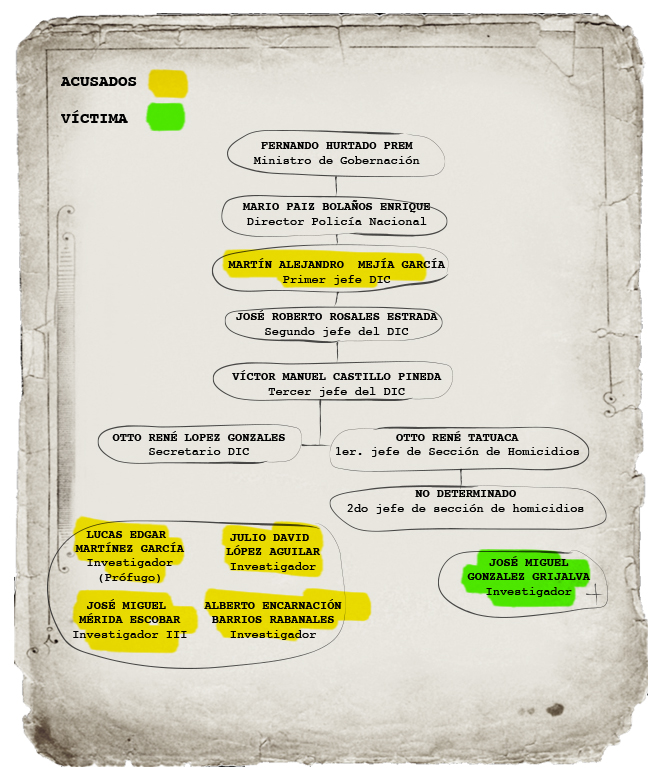
According to José Mariano Domingo Cabrera, a historian and expert witness proposed by the Public Prosecutor's Office, the National Police's command structure can be reconstructed using records from the National Police Historical Archive (AHPN). The expert explains that the Mérida case exemplifies the institution's strategies for concealing and obstructing investigations. Domingo maintains that this was not due to technical or professional incompetence. The police force was not a new institution, and many of its members had received international training. "Since Mack's murder, they had the capacity to objectively track down the killers," he states.
According to the historian, Mérida became an enemy of the state because of his investigation into Mack's murder, as evidenced by the fact that the police leadership shelved it. Rember Larios, who investigated the case alongside Mérida, stated that the file was hidden out of fear. Only he, Mérida Escobar, and Caballeros Seigné, the director, discussed the progress of the investigation into Myrna Mack's murder. "After finishing the investigation, we handed it over to Colonel Caballeros, who ordered that we not reveal it until he gave the go-ahead. So we proceeded to file it away," Larios recalls.
Good cop, bad cop
The declassified CIA documents conceal the names of their informants. But the versions these sources shared are not hidden, and there are at least two.
The initial version in the CIA's clandestine communications suggests that Mérida Escobar was a criminal. "Senior officers believe (the murder) is related to his involvement with a group of corrupt police officers," the report reads.
Reports indicate that Mérida belonged to a bank robbery gang along with fellow police officers Luis Castro Jiménez and Edgar Gálvez. The source states that Mérida betrayed his accomplices after a pool hall robbery in December 1990. The other officers were dismissed and prosecuted. When the two accomplices were released, they lent their car to a third former officer who was also part of the gang, and Mérida Escobar was killed.
Regarding this version of events, a National Police log confirms that Gálvez was dismissed after being accused of armed robbery and assault at a billiards hall on December 13, 1990, along with three other investigators from the DIC (Department of Criminal Investigations). Mérida, Castro, Gálvez, and Rubén Cabrera Castillo were suspended from their duties, according to a logbook from the investigations department . A record from the police personnel department confirms this . Mérida spent 18 days in jail for these accusations.
Another clue in the declassified documents : the car used to assassinate Mérida belonged to Alfredo de Jesús Guerra Galindo, who was dismissed from the police force in 1990 and was a member of the security detail for the then Deputy Minister of the Interior, Manuel González Rodas. Guerra Galindo was under investigation for three bank robberies. It is presumed that the gang used weapons and vehicles belonging to the Deputy Minister's entourage. Guerra Galindo states that he lent his car to either Castro or Gálvez (he did not specify which) and had no idea that it would be used to assassinate Mérida.
Guerra Galindo was formally charged with the murder of Mérida in 1991.
Another factor that leads us to believe this was a planned operation is that Guerra Galindo was captured 30 minutes after Mérida's murder, but in Zaragoza, Chimaltenango, 60 kilometers from Parque Concordia.
High-ranking officials at the Ministries of the Interior and Defense had a different theory . Another declassified document indicates that three colonels—the director of Military Intelligence, Marco Antonio González Taracena; the director of the National Police, Mario Paiz Bolaños; and the Minister of the Interior, Fernando Hurtado Prem—spread the rumor that the Presidential General Staff, headed by Colonel Luis Francisco Ortega Menaldo, was involved in the crime. The reason? Political. Mérida Escobar's investigative work to clarify Myrna Mack's death turned her murder into a tool to harm a political enemy, the report states.
These rumors are based on the fact that two members of the Presidential Guard (EMP), Marco Tulio López Raymundo and Juan Hernández Sánchez, were arrested by the police on July 9. Mérida allegedly participated in this operation. That same day, López and Hernández were removed from service. A document from the National Police Historical Archive (AHPN) corroborates this information. Another document reveals that the National Police's Joint Operations Center noted among its updates that it had transferred two personnel to the EMP that day.
Theories are emerging despite censorship in declassified CIA documents obtained through the National Security Archive , where Kate Doyle is an analyst and director of the Guatemala information project. Doyle explains the white boxes and redactions that conceal certain information: In the United States, there is a law that protects information sources and the methods used to produce intelligence. These documents also contain a code indicating a restriction. If this redacted information were revealed, it would harm the U.S. Security Agency.
The documents attribute certain actions to a “service,” but the name of that service is withheld. It could be the Presidential Service, the Secret Service, the Archives Service, the Intelligence Service, or another service, Doyle notes. Mostly, the documents refer, in English, to a service whose name is nine characters long. What is clear is that one service is trying to blame the other. From the documents, it can be inferred that the CIA was convinced that one service covered up the murder of Myrna Mack, and that the Guatemala office had sufficiently credible information to tell Washington how the government was trying to cover up the case.
Mérida's murder in today's courts
After being arrested in the Mérida Escobar case, Martín Alejandro Mejía, then head of the DIC (Department of Criminal Investigations), attempted to distance himself from the accusation, claiming he wasn't head of the department when Myrna Mack was murdered. While that is true, he was indeed head of the department when Mérida was killed. He stated, “…they talk about 'the plan.' The head was the one who planned it, I imagine, because I wasn't the head of the investigations department; I was second-in-command at that time,” he told Judge Miguel Ángel Gálvez of the High-Risk Court B, who was presiding over the case.
“The first chief carried out all the operations coordinated with the hierarchy that comes from the Minister of the Interior, President, director, deputy director, third chief and then me, as part of the organization, I am inside as second chief,” he added on that occasion.
If the prosecution's theory is that the murder of Mérida Escobar was a special intelligence operation aimed at ensuring impunity for the murder of Myrna Mack, those implicated include the administrations of Vinicio Cerezo (1985-1990) and Jorge Serrano Elías (1990-1993). They include Rember Larios and Martín Alejandro Mejía at the DIC (Department of Criminal Investigations). They also include Carlos Augusto Morales Villatoro and Fernando Hurtado Prem at the Ministry of the Interior. And Julio Caballeros Seigné and Enrique Paiz Bolaños at the head of the National Police are also implicated.
Helen Mack's theory about Mérida's murder unfolds in a series of steps: the target of the intelligence operation was his sister Myrna, and Mérida was killed to ensure impunity for that murder. To further ensure impunity for Mérida's murder, two innocent people were framed: Cifuentes Estrada and Guerra Galindo. One of them was murdered months later, and the other disappeared. "These are the necessary means to leave the Mérida case unresolved," and thus what the activist calls "the circle of impunity" is completed.
The two men accused of Mérida Escobar's murder were exonerated. On August 24, 1992, Cifuentes Estrada (who confesses in the video) and Guerra Galindo (the former police officer) were acquitted by a court. Cifuentes Estrada was murdered on December 1, 1992. When the Public Prosecutor's Office exhumed his remains upon reopening the Mérida case, they found similarities with one of the shots that killed Mérida Escobar—the shot that struck her jaw on the left side.
.

The police report indicates that Cifuentes attempted to rob a bakery and was killed. That night, the proper procedures for handling his body were not followed: it was not taken to the morgue, nor were any formalities performed. The body was released to his partner, who took it away.
No one has seen Guerra Galindo since July 1995.
The police officers who signed
In the legal proceedings to clarify the death of Mérida Escobar, the signatures on the documents are crucial. This record allows the Public Prosecutor's Office to demonstrate that the accused were aware of what was happening. Mérida Escobar signed and ratified the report that identifies Beteta as the one who actually killed Myrna Mack; the Public Prosecutor's Office theorizes that this is why he was killed. The three investigators named and their superior signed the arrest warrants for the accused in Mérida's murder, Guerra Galindo and Cifuentes Estrada; the prosecution uses this to justify their involvement in the intelligence operation that led to Mérida's death. Their signatures are the main piece of evidence holding this case together.
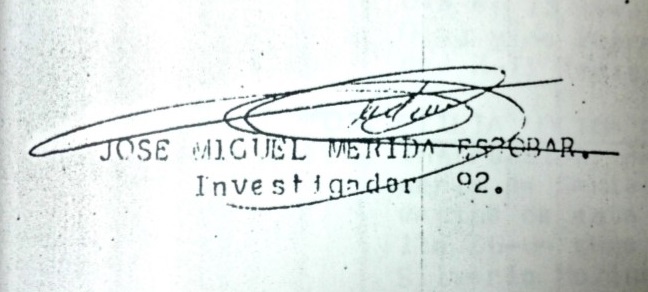
But there are other arguments for the prosecution as well. The principle of hierarchy, summarized at the hearing by Mejía García himself: there is a chain of command that communicates both upwards and downwards. At the top were the Minister of the Interior, the Director of the Police, and other high-ranking officials.
In the intermediate stage of this process—January 2016—lawyers Luis Fernando Ruiz Ramírez and Ana Reina Martínez Antón defended Mejía García, accusing the Public Prosecutor's Office and the private prosecutor of pressuring them to try their client alongside the other three police officers whose cases were already further along. According to lawyer Ruiz, this was to ensure his client's guilt and link him to the others.
A year later, on February 28, the oral debate began against Martín Mejía García, Alberto Barrios Rabanales, José González Grijalva and Julio López Aguilar before the High Risk Court C —presided over by Judge Pablo Xitumul— which will decide if the former police officers are guilty of staging the murder of their former co-worker.
* * *
Three days before he was murdered, Mérida Escobar accompanied his brother Ever to Amatitlán. During the journey, Mérida carried his pistol between his legs.
"Put that thing away," his brother told him.
—No way, I know they're going to attack me at any moment —the investigator replied, and told her about the threats against him, his fear of the targeted killing network known as “The Archive” and the case of Myrna Mack.
Ever Mérida remembers that a car started following them on the ring road. “Look, check the rearview mirror,” his brother told him. They couldn't see the driver because of the tinted windows, but Ever wrote down the license plate number on his hand. They stopped following them as they approached Villanueva. Ever arrived at his destination and washed his hands. The license plate number of the car that had followed them was erased. That was on a Friday. Three days later, Mérida's prophecy came true: he was murdered in Concordia Park, barely a hundred meters from the National Police headquarters. “The murder was on Monday. I understood why they followed us,” his brother recalls.
Ever Mérida recounts how González Grijalva once set a trap for his brother. He invited him to a “birthday party in Jutiapa,” and Mérida escaped because he traveled with his wife. Ever also remembers Barrios Rabanales. “I’ve known him since he was a child,” he says. He’s originally from a town near Catarina, San Marcos, where the Mérida brothers grew up. “When he came back, he’d brag about being with the Presidential General Staff, with G2, that he had power,” Ever says. His distrust extends to Rember Larios as well. “My sister-in-law remembers that he was at the police station when she went to ask for permission for Mérida, while he waited in Concordia Park, the day he was killed.” And as for the now-deceased Otto René Tatuaca, originally from Amatitlán, his brother would avoid streets to prevent running into him. “He can’t find a way to get at me,” Mérida Escobar would tell him. For Ever Mérida, the way the other officers acted can be summed up in one name: Judas.
Through witness testimony, expert witnesses, and evidence, the Public Prosecutor's Office intends to prove during the trial, which could last two weeks, that three of Mérida's former colleagues and her former boss are guilty of her murder. With this case, after almost 27 years, the murder of Myrna Mack would finally be brought to justice.
* * *